Leadership Starts with a Story

Because even the best leaders talk to themselves first.

There was a little boy who came to our program who had already been expelled from a few others. When he arrived, he carried a notebook from his teacher that was filled with difficult notes — lists of behaviors, warnings, and frustration. It was hard to read and I was just meeting him, but it was his mother who handed it to me and I’ll never forget her worried face. His new teacher, Mr. Matt, didn’t see a list. He saw a child; he extended his hand and they walked into the classroom together. 

Photo by Pixabay on Pexels.com

It was a privilege working alongside Mr. Matt. We spent time talking through his ideas, reflecting on challenges, and honestly laughing at each other as we learned. Within just a few weeks, Mr. Matt ran into my office one afternoon, tossed two books on my desk, and said, “He can read!” — it was a moment that changed everything. Not only could he read, he could read at an exceptional level.

We learned that his mother, who had very limited literacy skills herself, was reading to him and the other neighborhood children every night. She may not have known every word, but she knew the power of stories and what they could do for a child. Her love and effort sparked something that grew into confidence, connection, and advocacy. When we shared what we had discovered with her, again I’ll never forget her face — but this time filled with pride and relief.  

Photo by Kindel Media on Pexels.com

When we work with children who are exhibiting challenging behaviors, it can be easy to focus on what’s hard instead of what’s possible. But storytelling, especially the kind that starts with truth and compassion, shifts everything. It helps us see children, families, and even ourselves in fuller, more hopeful ways. It’s not about spin. It’s about seeing and sharing the moments that matter. 

As leaders and educators, our stories hold incredible power. They shape how we see our work, how we talk to ourselves, and how we talk to each other. And the way we talk to ourselves matters most. When we practice positive self-talk and give ourselves the same grace we give to a friend, we grow. The research backs this up: self-compassion increases resilience, improves decision-making, and strengthens relationships. But even more than that, it makes us human in the best way.

So, start with your story. Notice what makes you proud, what makes you curious, and what makes you brave. The way we talk about our work and ourselves creates ripples that go far beyond our classrooms.

Whether it’s a child learning to read, a teacher finding their voice, or a leader learning to trust their story, leadership always starts with a story.

It starts with how we talk to ourselves on the hard days, the ones that test our patience and even our why. It grows when we notice what’s good and what’s working, and choose to nurture that.

The truth is, the best storytellers aren’t the ones who speak the loudest. They’re the ones who listen closely, lead with heart, and keep learning right alongside their teams. When we find the courage to tell honest stories about our work, we build more than programs; we build trust, connection, and opportunity.

So tell your story.
The world is better when it hears it.

About the Author
Kim Stewart is the Director of Help Me Grow Western New York and PEDALS. Kim is on a lifelong mission to make the world a better place for all children.  

Embracing Risky Play in Early Childhood Programs: Why It Matters

Contributed by DAL Advisory Committee member, Jill Boeck

In an age of helicopter parenting and heightened safety concerns, the concept of risky play in early childhood can raise eyebrows. But increasing research and real-world observations show that taking measured risks in play is not only natural but essential to healthy child development. Rather than eliminating risk, high-quality early childhood programs are finding ways to manage and support risky play, helping children grow into confident, capable, and resilient individuals.

What Is Risky Play?

Risky play involves thrilling and exciting activities where children explore uncertainty and test their limits. Common forms include:

• Climbing higher than usual

• Rough-and-tumble play like wrestling

• Running at high speeds or through uneven terrain

• Using tools like sticks or child-safe hammers

• Exploring elements like water, fire (in controlled environments), or heights

• Play with loose parts (e.g., logs, tires, ropes)

It’s important to note that risky play is not reckless play. The goal isn’t danger—it’s about children learning to assess risks, solve problems, and build independence.

The Benefits of Risky Play

1. Builds Resilience and Confidence
When children face challenges and succeed, even after a few stumbles, they develop a sense of mastery and belief in their abilities.

2. Develops Risk Assessment Skills
Through experience, children learn to judge what feels too high or too fast, and what they’re capable of managing.

3. Enhances Physical Development
Climbing, balancing, and lifting heavy objects help build strength, coordination, and motor skills.

4. Encourages Creativity and Problem-Solving
Open-ended, risky environments require children to think critically and creatively.

5. Fosters Social Development
When kids collaborate in active play, they learn negotiation, turn-taking, and empathy.

Overcoming the Fear: What Educators Can Do

While the benefits are clear, supporting risky play in early childhood programs requires a shift in mindset and careful planning. Here are some strategies educators can use:

• Create a “Yes” Environment
Instead of saying “No, that’s too dangerous,” consider how the environment can be adjusted to allow the play more safely.

• Assess, Don’t Eliminate, Risk
Use risk-benefit assessments to identify hazards and how they can be managed rather than removed.

• Educate Families
Communicate with parents about the value of risky play and how it supports development.

• Model Safe Behavior and Language
Show children how to climb safely, use tools, or assess their own limits.

• Observe and Intervene Strategically
Be present, but not overbearing. Let children lead, stepping in only when truly necessary.

 Risky play isn’t about putting children in harm’s way—it’s about giving them the space to grow, explore, and thrive. Early childhood programs that embrace this approach foster resilient, confident, and curious learners who are better prepared for the complexities of life. By reframing our view of risk as a tool, not a threat, we open up a world of possibilities for young children.

Rust Keeler is a Risky Play guru you can visit him here for more strategies to supporting risky play:

Website https://rustykeeler.com/

Facebook page https://www.facebook.com/rustykeelerdesigns/

YouTube https://www.youtube.com/@rustykeeler

Keeping Life in Perspective

We’re happy to share this perspective from Career Advisor at the New York Early Childhood Professional Development Institute (and DAL committee member), Charla Smith.

Perspective:
a particular attitude toward or way of regarding
something; a point of view

In the years since COVID, I’ve often had to remind myself to keep life in “perspective.” It might sound a bit cliché, but how often do we truly think about our lives as a whole instead of just one day at a time? Probably not as often as we should—but it’s something we can gradually start doing.

So, how do you manage to keep perspective every day?
Do you pause to enjoy the little things?
Do you live each day like it’s your last?
Do you focus on something exciting in the future?
Or maybe you just push through the hard days, stress over the big things, and struggle to keep your goals in sight.

If I’m honest, I do all of these things—but not all at once and not every day. To keep life in perspective, I aim to strike a balance.

Each morning, I remind myself that I’m lucky to wake up alive. For those who know me, you know that grief and trauma have shaped my life in profound ways. I know some days will be harder than others, so I make it a point to take breaks and relax, even if it’s just dropping my shoulders during a stressful moment.

Life’s challenges don’t pause. As a parent of a teenager, stress is a constant companion, but I remind myself that the work I’m doing now will pay off in the long run.

Of course, not every day goes as planned. Some days feel completely off, and it’s easy to get stuck in frustration. When that happens, I try to step back and do a mental reset—a chance to recalibrate my perspective and move forward with a clearer mindset.

“Perspective.”

Some days, I’m simply thankful the day went well.
Some days, I reflect on what I could have done differently.
And some days, I laugh—or cry—looking back.

So, how do I put this into practice? Every night, as I get ready for bed, I take a moment to reflect. I think about how I can maintain perspective in both my professional and personal life. It’s a small ritual, but it makes a big difference.

As we move through 2025, I encourage you to do the same: add a little more “perspective” into your life. You might be surprised by how much it helps.

What is Leadership?

We’re happy to share this perspective on leadership from educational consultant (and DAL committee member), Christina Fecio.

“What is leadership?”

When I ask that question in a group, at least one person is always compelled to google it and/or someone answers it with an inspirational quote.

As a self-admitted “word nerd” I do love a good quote — but when I’m asking you a question, I’m more interested in your own response, in your own words. Your words give me insight about how you think and that insight is important to me.

So I’ve changed my approach a little and now I ask this:

Whose leadership has positively impacted your life? Think about that influential teacher, or coach, or supervisor who immediately comes to mind when you think “leader” and when you can see that face in your mind, ask yourself: “What did that person consistently do well?”

My next question is usually, “… and how did that make you feel?” That focus on feelings makes many people feel uncomfortable; vulnerability is uncomfortable. Yet, when we wait through the awkward pause and one brave soul speaks up? That’s where the magic happens.

When that first response makes it okay (for most people) to be vulnerable, we hear some powerful responses. We hear words like valued, appreciated, seen, and empowered. We hear words like happy, loved, respected, and joyful.

In those moments, we find an authentic answer to that very first question, “What is leadership?” — because we’re ready to focus on our potential to inspire those same feelings in others.

This post was originally published at https://christinafecio.com/2020/01/27/what-is-leadership/

Quick Tips: Managing Clearances

Directors in WNY have shared questions regarding the recent regulatory changes. Our first tip, of course, is to suggest open, honest communication with your licensor — don’t be afraid to call him/her with your questions.

Separately, we’d like to suggest checking out this informational video from OCFS, if you haven’t seen it yet:

Comprehensive Background Checks (15 minutes)

Last but not least, check out this summary created by Cheri and consider posting it in your office for easy reference.

If you need a visual cue, this “what to fax to your licensor” pic from Jessica might be helpful to you, too.

PS: Cheri and Jessica, both members of the DAL advisory committee, are open to your calls or emails if you want to chat about how they are managing these changes at their centers.

  • Email Cheri at nowickic (at) skiesthelimitllc (dot) com
  • Email Jessica at jessica (at) bloomcreativearts (dot) com

Quick Tip: Connect with Every Team Member, Every Day

Engaging in warm, positive, 1:1 daily interactions with children is recommended as a key strategy for building relationships with young children — but did you know it’s equally essential for adults?

Whether you’re commenting on something that you observed (“Hey, I appreciated that engagement you had with Dion”) or offering a simple, sincere “thank you” at the end of a shift, make it a point to connect with every team member, every day.

Your personal attention says, “I see you” — and being noticed helps team members feel valued and appreciated.

Quick Tip: Make a Short List

When you have a loooooooong to-do list that is interrupted by bathroom breaks, phone calls, and other things that reliably pop up, it’s easy to be busy all day long and still wrap up the day feeling like you didn’t accomplish anything.

A short list can help you stay focused and productive — and it’s as easy as it sounds. At the beginning of each day, make a short list of your top priorities; the short list becomes your to-do list…and it’s magical because it’s manageable!

Need a specific strategy? Try the 1-3-5 rule, explained in this article; 1 big thing + 3 medium things + 5 small things = a super satisfying to-do list!


Many thanks to Jessica Tollar for sharing today’s Quick Tip. A valued member of the DAL advisory committee, Jessica is the Director of Early Childhood Development and Curriculum for Care-a-Lot Child Care Centers and Bloom Creative Arts.

Quick Tip: Treats for Your Team

A new school year, like every season of change, is busy and can feel overwhelming to children and adults alike.

To help teachers manage the transition, add a little pick-me-up to your staff lounge. Show them you care with a “de-stress basket” that contains various teas, coffees, snacks, a stress ball and/or adult coloring pages, and most importantly, chocolate.

Lots of chocolate.


Many thanks to Kathy Kiblin for sharing today’s Quick Tip. Kathy is the Leadership Chairperson for the WNY Chapter of NYAEYC and an education specialist for Child Care Resource Network.

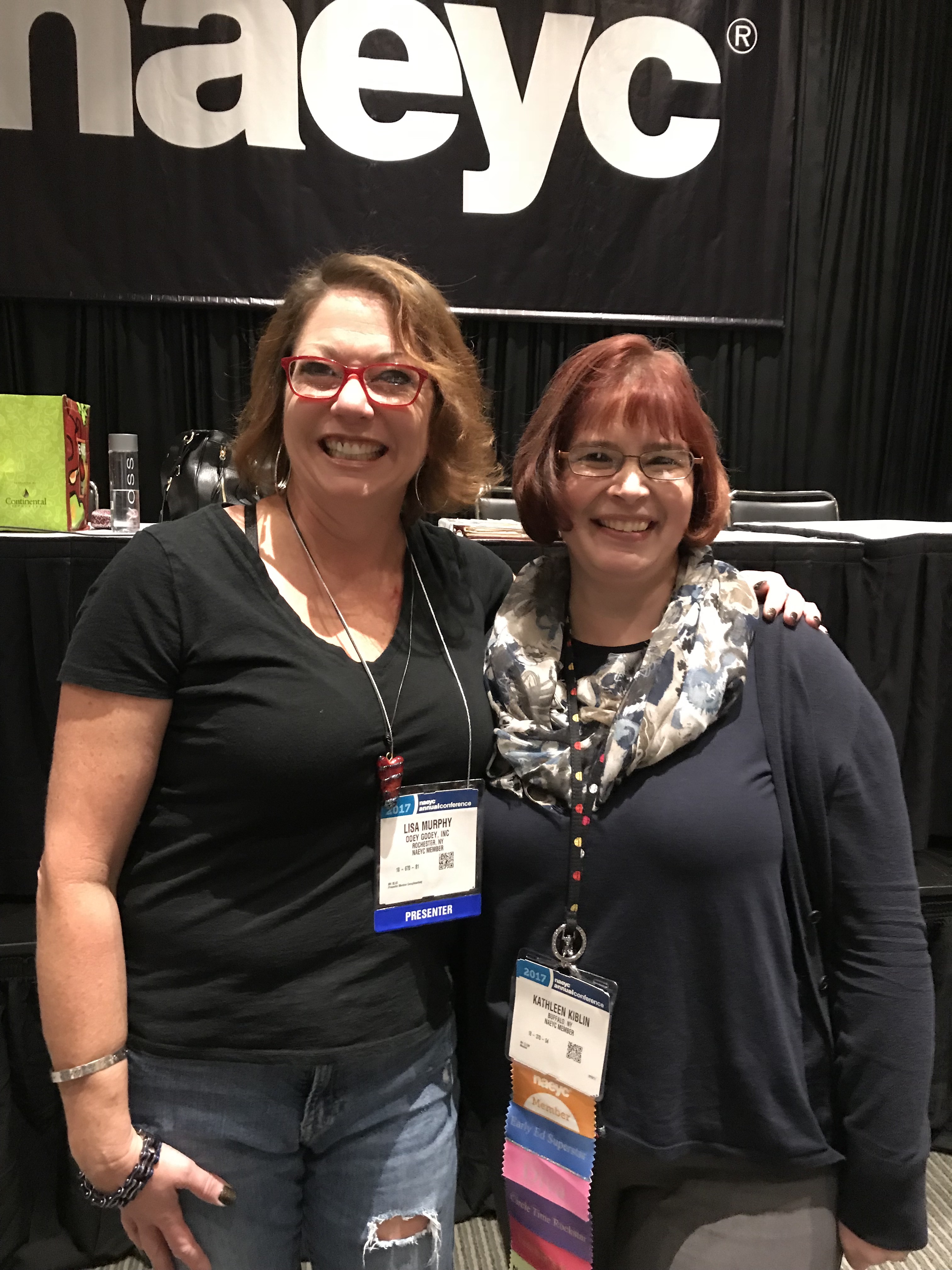
Kathy (right) pictured with Lisa Murphy (left) is a huge fan of the Ooey Gooey Lady — in fact, her second Quick Tip is that you should follow Lisa on social media!


Quick Tip: Think Positively!

In a world where we’re bombarded with negative information — social media, news, advertisements, and more — it can help your mindset (and your productivity) to focus on the positive.

Consider posting a few positive, inspirational quotes around your office and in shared spaces. Whether you jot them on sticky notes or create a fancy display, you’re adding a “feel good” vibe to your program — and that can never hurt!


Many thanks to Kim Suminski, CEO of Child Care Resource Network, for sharing today’s quick tip — and for sharing some of her favorite quotes, too!


Quick Tip: Don’t Skimp on Onboarding

When you have ratios that need to be met and a task list that seems to get longer each day, it can be tempting to take some shortcuts with new employees’ orientation.

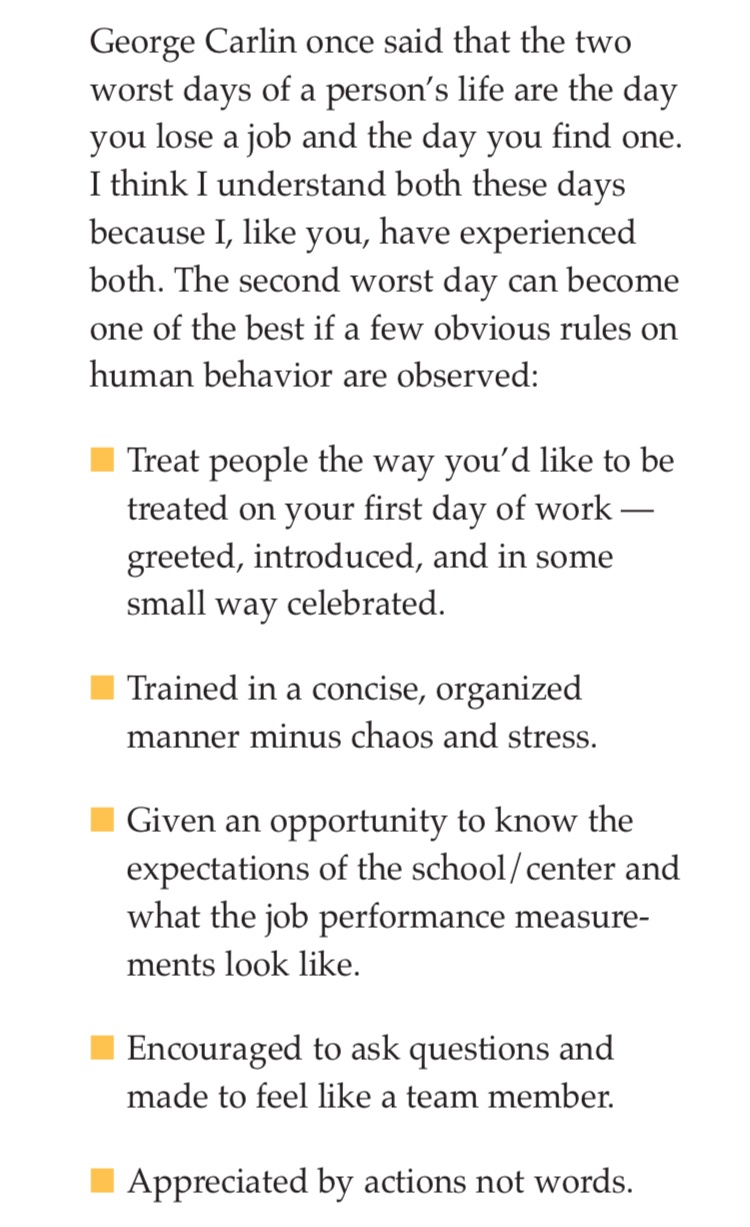
Today’s pro tip? Don’t skimp! The time (and effort) that you put into orientation has a direct impact on employee retention.

img_5181

…and if your orientation process needs a little pick-me-up, we’ve got you covered! Check out this great article.


Many thanks to Jill Boeck for sharing today’s Quick Tip.

A valued member of the DAL Advisory Committee, Jill is a Quality Improvement Specialist for QUALITYstarsNY.